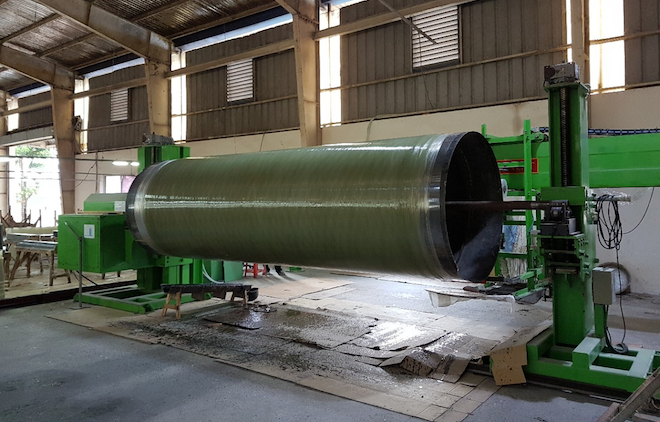
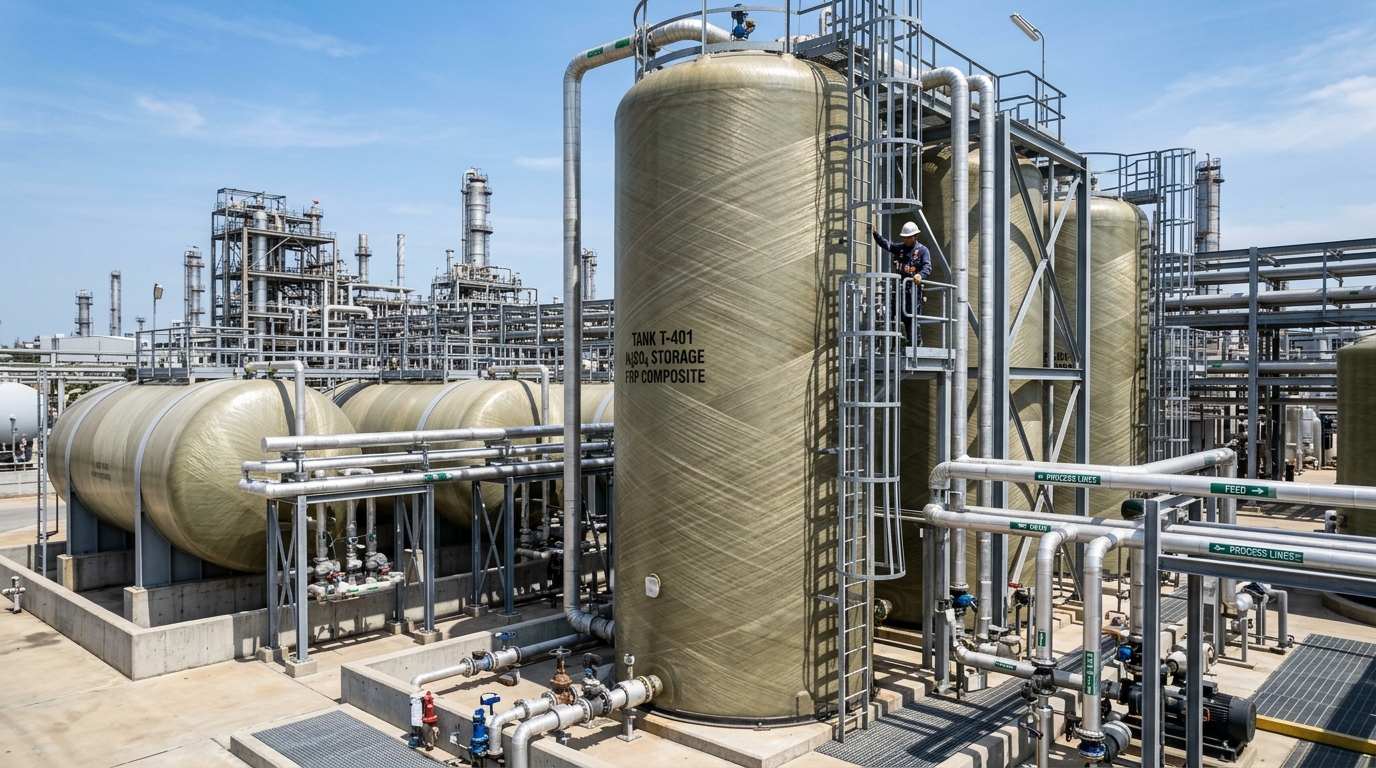
Selecting the correct storage vessel material for corrosive industrial chemicals is one of the most critical decisions in plant engineering. This guide provides a detailed head-to-head comparison between Fiberglass Reinforced Plastic (FRP), Stainless Steel (SUS 304/316), and High-Density Polyethylene (HDPE).
1. Chemical Resistance & Corrosive Media Compatibility
The primary reason industrial plants migrate away from metals is stress corrosion cracking, pitting, and galvanic degradation caused by acidic and chloride-rich media:
- Hydrochloric Acid (HCl 30% - 37%): Stainless steel fails catastrophically within weeks due to rapid chloride pitting. HDPE withstands room temperature but softens dramatically above 45°C. FRP with Vinyl Ester resin handles hot concentrated HCl up to 100°C without degradation.
- Sulfuric Acid (H2SO4 50% - 98%): Stainless steel corrodes rapidly at intermediate concentrations. FRP provides superior long-term performance across intermediate and high concentrations when formulated with specialized Novolac vinyl resins.
- Sodium Hypochlorite (Bleach / NaOCl): Highly aggressive oxidizer that attacks stainless steel weld seams. FRP tanks with BPO/DMA cured vinyl ester barrier liners are the global benchmark for municipal disinfection.
- Seawater & Brine: Pits stainless steel SUS 304 within months. FRP is 100% non-conductive, chemically inert, and zero-corrosion in marine environments.
2. Comprehensive Engineering Comparison Matrix
| Evaluation Criteria | FRP Composite Tanks | Stainless Steel (SUS 304/316) | HDPE / Poly Tanks |
|---|---|---|---|
| Corrosion Resistance | Outstanding (Impervious to acids, alkalis, salts) | Poor to Fair (Vulnerable to chloride pitting) | Moderate (Good at low temp, poor with oxidizers) |
| Max Operating Temp | -40°C up to +120°C | Up to 400°C | Limited to 50°C - 60°C max |
| Structural Rigidity | High tensile & flexural modulus | Very High | Low (Prone to creep and bulging) |
| Large Volume Capacity | Custom up to 150m³+ per vessel | Unlimited on-site welded | Limited typically to < 30m³ |
| Outdoor UV Durability | Excellent (Gelcoat UV inhibitors) | Excellent | Moderate (Embrittles over 7-10 yrs) |
| Initial CAPEX Cost | Competitive / Medium | High to Very High | Lowest Initial Cost |
| Expected Lifespan | 25 to 30+ Years | 5 to 15 Years (corrosion dependent) | 8 to 12 Years |
| Repairability | Seamless in-situ laminating patch | Complex specialized welding | Nearly impossible to reliably weld |
3. Total Cost of Ownership (TCO) & 30-Year Lifecycle Value
While rotationally molded HDPE tanks feature the lowest initial acquisition price, their operational lifespan rarely exceeds 8–10 years under outdoor sun and chemical thermal cycling. Frequent tank replacements, disposal headaches, and chemical leakage risks elevate long-term costs significantly.
Stainless steel requires massive upfront capital and suffers costly maintenance shut-downs when welds fail under localized pitting. In contrast, engineered FRP tanks provide the lowest 30-year Total Cost of Ownership by delivering three decades of maintenance-free continuous operation.
4. Conclusion: When to Choose FRP Composite Tanks?
FRP composite tanks from New Viet Han are the definitive choice when your application involves:
- Storage of corrosive inorganic acids, aggressive alkalis, or high-chloride chemicals.
- Large volumes (exceeding 10m³ to 150m³) where seamless structural integrity is mandatory.
- Installations in coastal, marine, or humid tropical environments where external atmospheric corrosion is severe.
- Zero maintenance allowance to ensure continuous 24/7 plant production uptime.
For custom engineering consultations, material compatibility verification, and direct factory pricing, get in touch with New Viet Han’s engineering department at susan@newviethan.com or call +84-91-800-2385.