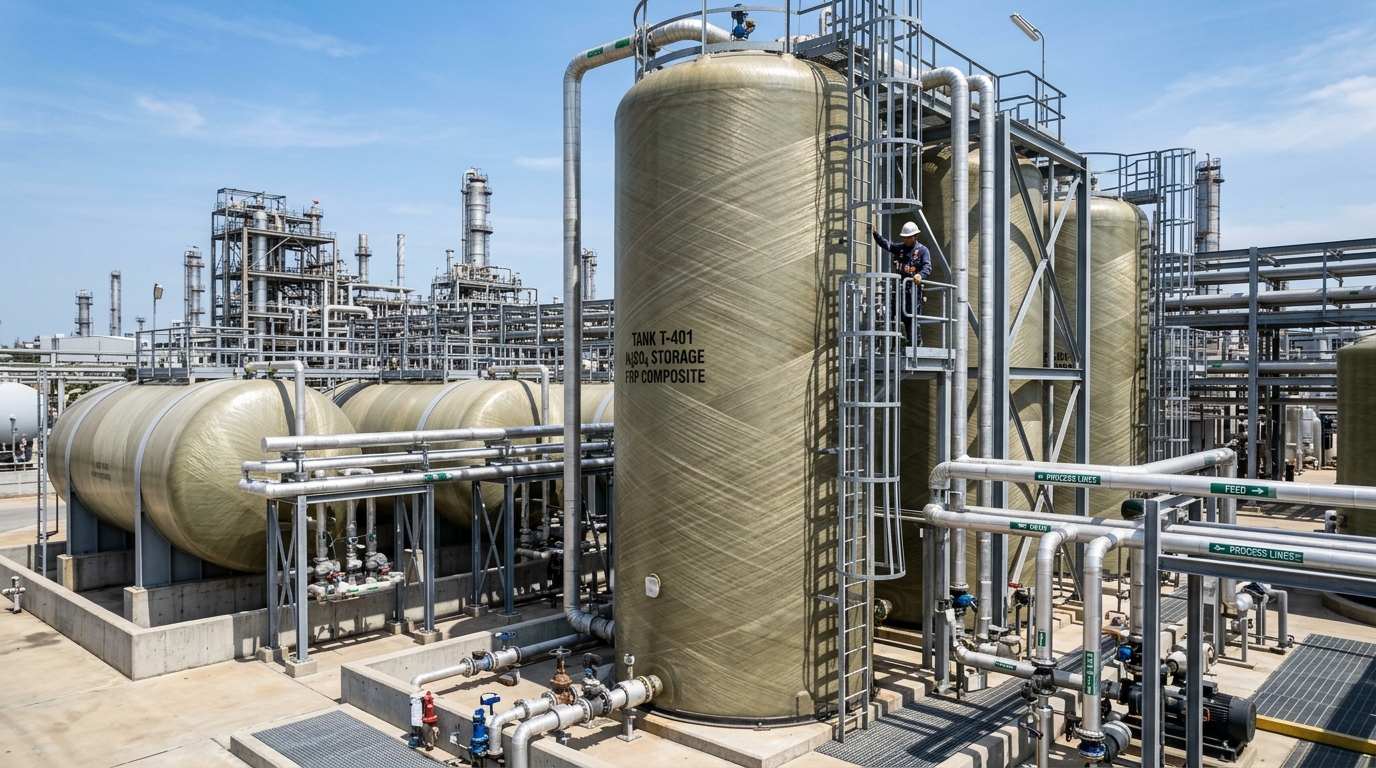
Filament Winding represents the pinnacle of automated composites manufacturing. By precisely orienting continuous structural glass rovings under controlled computerized tension, New Viet Han produces cylindrical vessels and pressure piping with exceptional strength-to-weight ratios and unmatched chemical resistance.
1. What is Automated Filament Winding Technology?
Filament winding is an automated fabrication technique where continuous strands of high-tensile structural fiber (typically E-glass or corrosion-resistant E-CR glass) are impregnated through an optimized polymer resin bath and wound precisely onto a rotating mandrel under computerized multi-axis CNC control.
Unlike manual contact lay-up, filament winding delivers:
- Extreme Structural Uniformity: Uniform glass-to-resin ratio (up to 65% - 75% structural glass content), yielding superior hoop tensile strength.
- Continuous Seamless Construction: No mechanical joints or weak weld seams along the cylinder body, eliminating leak hazards.
- Computerized Helix Precision: Winding angles can be custom-programmed from 45° to 88° depending on whether internal burst pressure (hoop stress) or longitudinal bending loads govern the design.
2. International Design Standards: ASTM D3299 & BS 4994
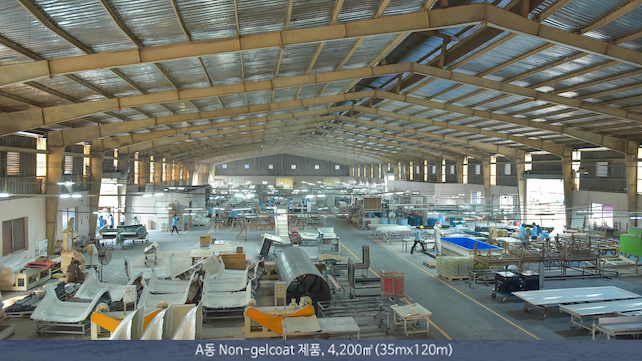
At New Viet Han’s 28,800 m² factory in Dong Nai, Vietnam, all filament wound tanks and pipe systems are engineered strictly in accordance with recognized international engineering codes:
- ASTM D3299: Standard Specification for Filament-Wound Glass-Fiber-Reinforced Thermoset Resin Corrosion-Resistant Tanks.
- ASTM D4097: Standard Specification for Contact-Molded Glass-Fiber-Reinforced Thermoset Chemical Equipment.
- BS 4994: British Standard Specification for the design and construction of vessels and tanks in reinforced plastics.
- ASME RTP-1: Reinforced Thermoset Plastic Corrosion-Resistant Equipment.
3. Multi-Layer Cross-Section Architecture
Every filament wound vessel engineered for aggressive chemicals comprises three distinct laminate zones:
3.1 Inner Chemical Corrosion Barrier (2.5mm – 3.5mm)
The interior layer in direct contact with corrosive media. Formulated with pure Vinyl Ester resin (Derakane 411, Swancor 901) reinforced by a 0.25mm synthetic/C-glass surfacing veil (90% resin richness), followed by two layers of 450 g/m² Chopped Strand Mat (CSM). This delivers an impenetrable barrier against concentrated sulfuric, hydrochloric, and hydrofluoric acids.
3.2 Filament Wound Structural Layer
The primary load-bearing core consisting of continuous roving strands wound in alternating helical patterns. Calculates wall thickness to ensure a minimum structural safety factor of 10:1 under maximum design pressure and hydrostatic liquid head.
3.3 Outer Protection & UV-Shield Layer
The external coat enriched with UV absorbers, paraffin wax, and flame-retardant pigments to resist severe tropical weather exposure, sunlight photodegradation, and chemical splash.
4. Technical Specifications & Dimension Capacity
| Parameter | Factory Specification | Engineering Advantage |
|---|---|---|
| Diameter Capacity | Ø500mm up to Ø4,000mm | Covers small dosing tanks to large bulk municipal silos |
| Length / Height Capacity | Up to 14 meters in single cylinder piece | Reduces on-site assembly and field welding |
| Design Pressure | Full vacuum (-1 bar) up to 25 bar (2.5 MPa) | Suitable for high-pressure process pipelines |
| Operating Temperature | -40°C to +120°C (depending on resin grade) | Handles hot acidic exhausts and thermal cooling lines |
| Design Life Expectancy | 30+ Years with zero structural degradation | Dramatically outperforms rubber-lined steel |
5. Japanese Quality Assurance (QA/QC) & Factory Testing
Upholding our Japanese-transferred management philosophy, New Viet Han inspects 100% of filament wound products prior to export packaging:
- Barcol Hardness Testing (ASTM D2583): Verifying minimum 90% full resin polymerization cure.
- Ultrasonic Wall Thickness Gauging: Mapping shell thickness across 24 grid points to verify compliance with engineering blueprints.
- Hydrostatic Leakage Testing: Vessels filled to 100% test capacity and held for 24 hours with zero pressure drop or weeping.
- Acetone Wipe Chemical Cure Verification: Ensuring total barrier integrity.
6. Request a Technical Drawing Review & Export Quotation
New Viet Han exports custom filament wound tanks and process piping to Japan, South Korea, and international EPC projects worldwide. Send your process data sheets, chemical concentrations, and CAD drawings to our engineering team for a comprehensive technical and pricing proposal within 24 hours.
Contact SUSAN (International Sales Director):
- Email: susan@newviethan.com
- Hotline: +84-91-800-2385
- Online RFQ Portal: Submit Quotation Request